
Inhoudsopgave
- Wat maakt olijfolie geschikt voor gastronomische gerechten
- Het verschil tussen extra vierge en vierge olijfolie
- Olijfolie rookpunt uitgelegd: wanneer je welke olie gebruikt
- Smaakprofielen en olijfvariëteiten voor verschillende gerechten
- Kwaliteitsindicatoren: zuurgraad, polyfenolen en terroir
- Opslag en versheid: hoe je olijfolie optimaal bewaart
- Pairing-gids: olijfolie kiezen voor specifieke ingrediënten
- Aanbevelingen voor professionele keuken en thuiskoks
Laatst bijgewerkt: 13 augustus 2026
Wat maakt olijfolie geschikt voor gastronomische gerechten
De beste olijfolie voor gastronomische gerechten is veel meer dan alleen een kookmedium - het is een ingrediënt met karakter, een uitgesproken smaakprofiel en een duidelijk doel. A chef who sees olive oil only as "oil to cook with" misses what it truly contributes to a dish. Aurelia Oils has spent years selecting olive varieties that are technically superior and add the flavor dimension that separates gastronomic cooking from everyday meals.
What makes olive oil suitable for gastronomic use? First: quality at harvest. Olives picked at the right moment, processed within hours, and extracted through cold pressing retain their natural aromas and nutrients. An olive oil with acidity below 0.8% signals that fruit was in perfect condition. Polyphenols, natural antioxidants in olive oil, determine flavor intensity and peppery character. Higher polyphenol content means more personality.
Second: consistency. Professional kitchens can't tolerate surprises. Every bottle must deliver the same taste, color, and chemical composition. This requires strict cultivation and processing standards that most commercial oils don't guarantee. Aurelia Oils builds in traceability; you know exactly which olives are in your bottle and when they were harvested.
Third: versatility. A gastronomic olive oil must work in heat when needed, yet show its full potential in raw applications. That demands careful balance between acidity, flavor profile, and physical stability.
Het verschil tussen extra vierge en vierge olijfolie
Extra virgin and virgin olive oil sound nearly identical, but the differences are fundamental and directly determine how you'll use them.
Extra virgin olive oil is the least processed product. It's obtained through mechanical pressing alone, no chemicals, no heat above 27°C, no blending with other oils. Acidity can't exceed 0.8%. This is what you want for gastronomic cooking because all flavor components, polyphenols, and aromas remain intact. Extra virgin has a distinct profile: fruity, peppery, sometimes bitter. Those characteristics are precisely why you choose it.
Virgin olive oil undergoes the same cold pressing but allows acidity up to 2%. This happens when olives sit longer before processing or when fruit wasn't in perfect condition. Virgin oil is edible and works in many dishes, but it lacks the refinement and intensity of extra virgin. For professional kitchens, it's frankly not worth the investment, you pay nearly the same for noticeably less flavor.
Refined olive oils (made through chemical processing of inferior fruit) don't belong in a gastronomic kitchen. They have no flavor and minimal nutritional value.
The choice is straightforward: for gastronomic cooking, always choose extra virgin. The price difference is minimal compared to the quality gap. Doleon Ultra Premium, made from Koroneiki olives in Greece, exemplifies what extra virgin truly can be.

Olijfolie rookpunt uitgelegd: wanneer je welke olie gebruikt
Dit is waar de verwarring meestal ontstaat. You've probably heard that you can't heat extra virgin olive oil. That's both right and wrong.
The smoke point is the temperature at which oil begins smoking and chemically breaks down. Extra virgin olive oil has a smoke point around 160-190°C, depending on composition. It's lower than many oils, but still high enough for many gastronomic applications.
The truth: you can use extra virgin for light sautéing, for gently cooking vegetables, even for brief baking. It fails only when you attempt deep frying or sustained high-heat cooking where you're constantly stirring and heating the oil.
Why does this matter? Because extra virgin loses its flavor above certain temperatures. Polyphenols break down, aromas vanish. You're wasting the oil's potential. So the rule isn't "don't heat it," but rather "heat it only when temperature stays low and time stays short."
For high-temperature work, deep frying, sustained roasting, prolonged braising, use refined olive oil or another fat. Honestly though: if you're deep frying, you're not cooking at a gastronomic level. Gastronomic cooking uses extra virgin for flavor, not as a technical cooking medium.
Practical guideline: use extra virgin for temperatures up to 160°C. Below that, go freely. Above it, stop and choose something else.
Smaakprofielen en olijfvariëteiten voor verschillende gerechten
Olive oil isn't interchangeable. The olive variety determines everything: color, taste, aroma, and which dishes it enhances.
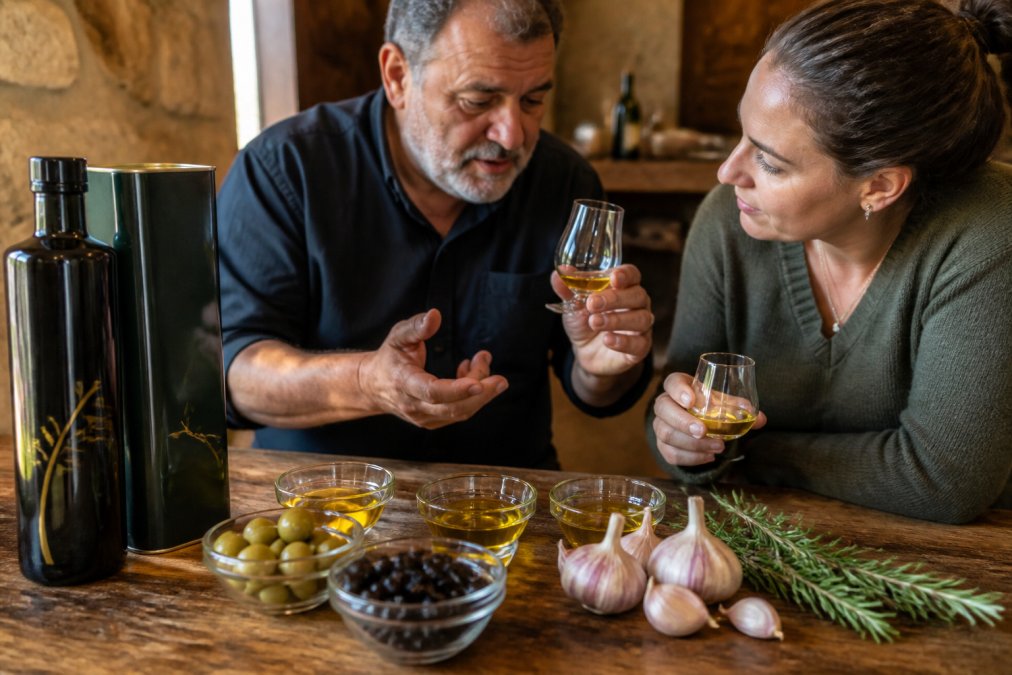
Koroneiki: fruitig en peperig
Koroneiki olives grow primarily in Greece and produce immediately recognizable oil. The flavor profile is fruity, green grass, green apple, sometimes nuts, with a characteristic peppery finish in the throat. That pepper comes from polyphenols and signals quality; it means the oil is packed with antioxidants.
Koroneiki works well on dishes needing a flavor accent. Drizzle it over soup just before serving. Use it on grilled fish. Mix it into vinaigrette for salad. It enhances without dominating, unless you want it to. Doleon Ultra Premium exemplifies what Koroneiki can achieve: fruity, peppery character with silky texture indicating perfectly ripe olives.
Blend versus monocultivar
A monocultivar is olive oil from a single olive variety. A blend combines multiple types. Both have their place, serving different purposes.
Monocultivar oils have clear identity. They're ideal when you want the oil's flavor profile itself to shine. With subtle dishes, simple pasta with garlic and red pepper, you want a monocultivar that doesn't steal the spotlight. Koroneiki monocultivar's work well here because they're characterful yet not overwhelming.
Blends balance flavors. A producer mixes varieties to achieve a specific profile that's more stable season to season. Blends also benefit kitchens making diverse dishes and wanting a "house style" oil that supports everything. Forelia "2 Roots" is designed for daily use, offering balanced, clean flavor that adapts to what you add.

For gastronomic cooking: start with monocultivars when experimenting with flavor profiles. Use blends when you need consistency across many dishes.
Kwaliteitsindicatoren: zuurgraad, polyfenolen en terroir
How do you know if you truly have good olive oil? Three things reveal quality.
Acidity is the first and most measurable. Acidity isn't about taste, it's a chemical measure of free fatty acids. Lower is better; it indicates better olives and faster processing. Extra virgin allows maximum 0.8% acidity. Many quality oils sit around 0.2-0.5%. This number should appear on the label. Without it, the producer is hiding.
Polyphenols are natural antioxidants. They create that characteristic throat pepper and dark green color. Polyphenols are also why olive oil is healthy. High polyphenol content (above 250 mg/kg) indicates early-harvest olives processed quickly. This signals quality. Many mass producers actually choose low polyphenols because they taste milder and appeal to more consumers. For gastronomic purposes, you want the opposite.
Terroir is where olives grow. Greece, Italy, Spain, each country, region, and farm produces something different. Greece is known for full, characterful oils. Italy for refined, often floral ones. Spain for cleaner, more neutral profiles. This isn't better or worse, just different. For gastronomic cooking, choose terroir based on what your dish needs. A Greek oil with strong character suits bold flavors. An Italian oil with subtle floral notes suits delicate fish.
Aurelia Oils works directly with Greek producers, meaning you know exactly what you're getting: oils with Greek characteristics, fruity, peppery, full, without intermediaries compromising quality.
Opslag en versheid: hoe je olijfolie optimaal bewaart
Olive oil isn't infinitely stable. It degrades through light, heat, and oxygen. How you store it determines how long it maintains quality.
Dark bottles aren't just attractive, they're necessary. Light, especially sunlight, breaks down polyphenols and causes oxidation. Glass beats plastic because plastic is porous and lets oxygen through. Dark glass is best.
Temperature must be stable and cool. Ideally 12-16°C. Your kitchen is probably warmer, so a dark cabinet away from the stove beats the countertop. Not the refrigerator, cold causes cloudiness and can affect flavor. Just a dark, cool place.
Oxygen is the enemy. Seal bottles tightly. Don't pour directly from a large bottle into your dish; transfer what you need to a smaller bottle for daily use. This limits how much of the main bottle gets exposed to air.
Freshness is essential. Olive oil is best in its first year after harvest. After two years, polyphenols noticeably decline. This is why harvest dates matter. Aurelia Oils always lists the harvest year so you know what you're getting.
Practical rule: buy quantities you'll use within a year. For professional kitchens with high volume, this is straightforward. For home cooks: buy 500ml bottles rather than 1L if you don't use much. Forelia "2 Roots" in 500ml is perfect, small enough to stay fresh, large enough to offer value.
Pairing-gids: olijfolie kiezen voor specifieke ingrediënten
The best olive oil for gastronomic dishes isn't universal, it's context-dependent. Ingredients determine which oil makes most sense.
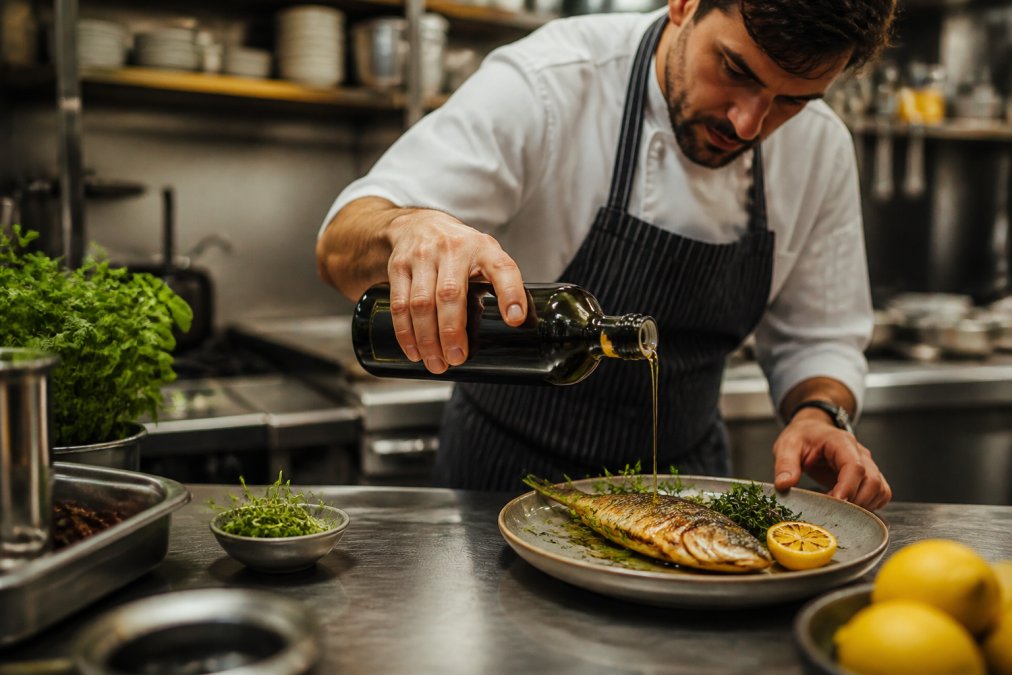
For fish and seafood: choose olive oil with subtle, clean flavors. Light fruity notes work. Heavy, peppery oils overshadow delicate fish flavor. A blend like Forelia "2 Roots" is perfect here, it enhances without dominating.
For meat: you can be more aggressive. Red meat, especially grilled, pairs well with full, peppery oils. Koroneiki monocultivar's shine here. The pepper complements smoke and roasting flavors. Doleon Ultra Premium is designed for such applications.
For vegetables: this depends on preparation. Grilled vegetables can handle full oil. Raw vegetables in salad need more nuance. Think about what the vegetable itself offers and complement rather than overpower.
For soups and broths: add olive oil at the end, not the beginning. A light, clean oil works better because you don't want it taking over. This is where blends show their strength.
For bread and dips: here you want character. A full, peppery oil is ideal. This is where you want a monocultivar like Koroneiki, flavor takes center stage.
For pasta: this is more nuanced. Simple pasta with oil and garlic demands full oil. Pasta with tomato sauce? Something lighter. Pasta with seafood? Subtle and clean. The oil should support the sauce, not compete with it.
The rule is simple: match intensity with intensity. Strong dishes can handle strong oils. Subtle dishes drown in them.
Aanbevelingen voor professionele keuken en thuiskoks
The best olive oil for gastronomic cooking doesn't really differ between professional kitchens and home kitchens. The criteria are identical: quality, consistency, flavor profile. What differs is scale and frequency.
For professional kitchens: you need two things: consistency and volume. Every bottle must be identical to the last, or guests ordering the same dish twice will notice different results. This is why direct relationships with producers matter. Aurelia Oils offers a HoReCa B2B-programma specifically for restaurants and hotels, guaranteeing the same oil batch after batch, season after season. Beyond supply, they also host kookworkshops en degustatie-evenementen that help your team deepen their understanding of oil selection and pairing.
Choose one or two oils and learn them thoroughly. One full, peppery for finishing and accent. One lighter, more neutral for daily use. This simplifies operations and ensures consistency.
For home cooks: you have more freedom. You can experiment with different varieties and terroirs. Start with a good all-rounder like Forelia "2 Roots" that works in many situations. Then add a specialist oil, something fuller and more characterful for finishing touches. This gives you practical flexibility and flavor exploration. If you want to deepen your knowledge, Aurelia Oils offers kookworkshops for individuals and groups, where you can learn directly from experts how to select and use oils at a gastronomic level.
Both groups should invest in quality. This isn't the moment to economize. Good extra virgin costs more upfront, but you use less because the flavor is more intense. Cheap oil requires more volume to achieve the same effect.
The best olive oil for gastronomic cooking supports your goals: flavor, health, consistency. This requires understanding acidity, polyphenols, and terroir. It also requires honesty about smoke points and pairing choices. Aurelia Oils makes this easier by offering oils that are traceable, consistent, and designed for serious cooks, whether at home or in restaurants. Shop your favorites and experience the difference true quality makes.
Veelgestelde Vragen
Wat is het verschil tussen extra vierge en gewone olijfolie voor gastronomisch gebruik?
Extra vierge olijfolie wordt koudgeperst en heeft een zuurgraad onder 0,8%, wat zorgt voor meer smaak, aroma en antioxidanten zoals polyfenolen. Gewone olijfolie is geraffineerd en minder geschikt voor gastronomische toepassingen omdat de smaak veel minder uitgesproken is. Voor professionele chefs en veeleisende thuiskoks is extra vierge essentieel omdat het de smaak van gerechten echt kan transformeren.
Welke olijfolie is het beste voor warme bereidingen en welke voor rauw gebruik?
Extra vierge olijfolie met een hoger rookpunt (rond 190-210°C) kan voor licht braden gebruikt worden, maar is vooral geschikt voor rauw gebruik: dressings, marinades en finishing touches. Voor hete bereidingen kies je olijfolie met een hoger rookpunt of gebruik je raffinée olijfolie. Het hangt af van de zuurgraad en samenstelling, een olie met lagere polyfenolen heeft een hoger rookpunt, maar minder smaak.
Hoe herken je echt kwalitatieve olijfolie van marketing-praatjes?
Zoek naar olijfolies die hun oogstjaar vermelden, de zuurgraad aangeven (onder 0,8% voor extra vierge), en details over de variëteit en herkomst delen. Biologische certificering en internationale keurmerken helpen, maar het meest betrouwbaar is het proeven, goede olijfolie heeft een duidelijk fruitig aroma, mogelijk met gras- of kruidnoten, en een peperige afdronk in de keel. Veel supermarktmerken gebruiken vage termen als 'premium' zonder concrete informatie.
Waarom kost betere olijfolie meer, en is die prijs gerechtvaardigd?
Premium olijfolie kost meer omdat het van beter geselecteerde olijven gemaakt is, binnen uren na plukken koudgeperst wordt, en minder opbrengst per boom heeft. De hogere polyfenolgehalte, fijnere smaak en betere consistentie van batch tot batch rechtvaardigen de prijs voor professionele toepassingen. Voor een chef die olijfolie als hoofdingrediënt gebruikt, is het verschil echt proefbaar; voor iemand die het alleen voor dressings gebruikt, kan een goede middenklasse volstaan.
This article was written using GrandRanker